Top Motorized Pergola Manufacturers for Global Buyers
The global market for outdoor living is moving beyond fixed shade structures. Buyers now expect adjustable roofs, quiet motors, integrated lighting, and weather-responsive controls. This shift makes Motorized Pergola systems increasingly relevant for hotels, restaurants, residential developers, and premium homeowners.
Industry reports show strong demand, although market boundaries differ. Grand View Research has identified outdoor furniture and outdoor living as expanding global categories, supported by residential renovation and hospitality investment. Fortune Business Insights has also reported steady growth in the broader outdoor furniture market through the decade. Meanwhile, smart-home research from MarketsandMarkets points to rising consumer interest in connected controls and automated comfort systems. These reports do not measure pergolas in exactly the same way. That limitation matters.
A reliable manufacturer must offer more than an attractive aluminum frame. Global buyers should examine motor torque, drainage design, powder-coating performance, wind-load testing, spare-part access, and documented quality controls. For example, a 3-by-4-meter terrace may need different reinforcement from a smaller balcony installation. Rain sensors should respond consistently, while manual overrides must remain simple during power interruptions. Installation drawings, packaging standards, warranty terms, and realistic production lead times also deserve close review.
Experience reveals a difficult truth. A low purchase price can hide costly installation problems. Some suppliers publish impressive specifications but provide limited technical evidence. This guide evaluates leading Motorized Pergola manufacturers through product capability, customization, certifications, communication, and after-sales support. The ranking is not absolute. Climate, project scale, local codes, and installer expertise can change the best choice. Careful comparison remains essential.
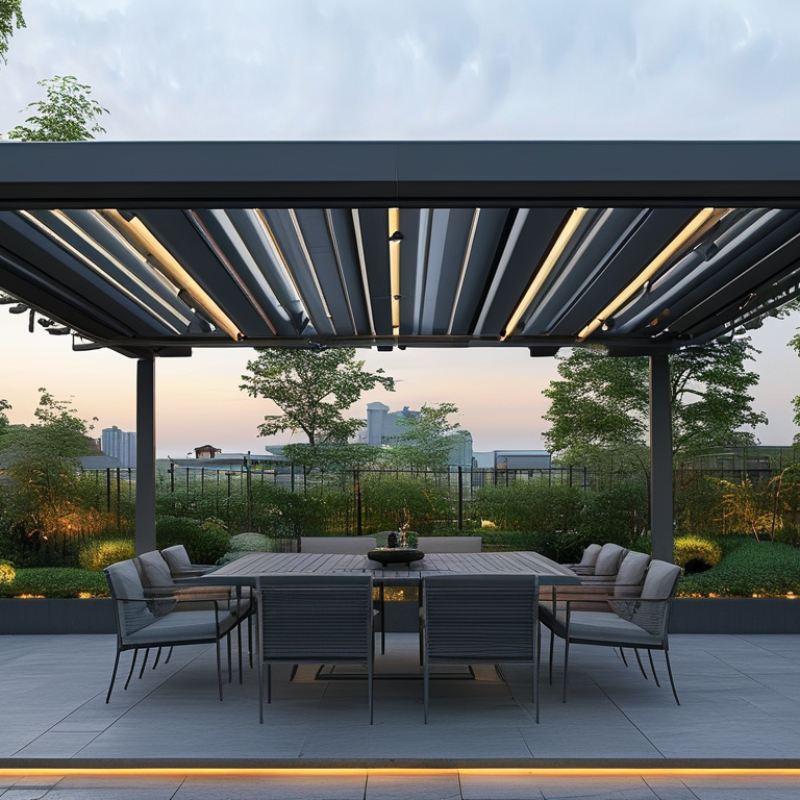
Global Market Mapping: 2024–2030 Demand Segments and Growth Metrics
Top Motorized Pergola Manufacturers for Global Buyers
Global Market Mapping: 2024–2030 Demand Segments and Growth Metrics
A practical market map starts with climate, property type, and installation complexity. From 2024 to 2030, demand is expected to rise steadily, with many regional estimates indicating roughly 6%–9% annual growth. Residential buyers remain the largest segment. They often seek weather protection, quiet motors, and app-based controls. Hospitality projects are expanding faster in some cities. Restaurants and resorts need durable systems for terraces, pool decks, and seasonal seating.
Commercial demand is more specification-driven. Buyers compare wind ratings, drainage design, corrosion resistance, warranty terms, and local service capacity. Aluminum structures with integrated lighting are gaining attention, especially in coastal and high-sun markets. However, growth will not be uniform. Currency pressure, construction slowdowns, and permitting delays may weaken short-term orders. Market forecasts can look precise, but installation data is still uneven across regions.
Tips: Request tested wind-load documentation, sample finish panels, motor noise readings, and a written spare-parts plan. Check whether installers understand local snow, rain, and electrical conditions. A low factory price may become expensive after freight, customs, site preparation, and service visits. I would also compare three quotations, not just two. That small discipline often exposes missing accessories or unrealistic delivery promises.
Performance Benchmarks: 120 km/h Wind Ratings, IP65 Motors, and Drainage
For global buyers, motorized pergola performance begins with the wind rating, not the finish. A 120 km/h rating sounds reassuring, but it needs context. Ask whether testing covered the complete structure, louvers, posts, and anchoring system. A frame may survive controlled pressure yet fail on an exposed coastal terrace. I have seen drawings look strong while foundation details remained vague. That gap deserves attention.
The motor is another practical checkpoint. An IP65 enclosure resists dust and water jets, making it suitable for demanding outdoor use. It does not mean the motor can stay submerged or ignore poor cable routing. Confirm the operating cycle, thermal protection, noise level, and manual override. During inspection, run the louvers repeatedly after rain. Small hesitation can reveal alignment or drainage problems early. Specifications matter. Field behavior matters more.
Drainage should be visible in the design. Water needs a planned path through integrated gutters, downspouts, and clear discharge points. Ask for outlet dimensions and cleaning access, especially where leaves collect. A narrow channel may overflow during a sudden storm. That is easy to miss. Request test records, installation tolerances, maintenance instructions, and regional load calculations. Reliable manufacturers explain limits instead of promising universal performance. Buyers should compare local wind exposure, snow load, and installer competence. The strongest product can perform poorly when site assumptions are wrong.
Top Motorized Pergola Manufacturers for Global Buyers
Performance benchmarks: wind resistance, motor ingress protection, and roof drainage design targets.
Wind rating A 120 km/h rating equals approximately 33.3 m/s and represents a substantial performance target for outdoor motorized pergola systems.
Motor protection IP65 indicates a dust-tight enclosure protected against water jets, based on the IEC 60529 ingress-protection classification.
Drainage design Drainage performance should be verified against the project rainfall intensity, roof area, outlet capacity, and overflow provisions.
Regional Compliance: 110/220–240 V Systems, IEC 60529, and Local Codes
Top Motorized Pergola Manufacturers for Global Buyers
Regional Compliance: 110/220–240 V Systems, IEC 60529, and Local Codes
Choosing a motorized pergola manufacturer requires more than comparing canopy size and delivery prices. Electrical compatibility must match the installation country. A 110 V motor is not automatically suitable for a 220–240 V supply. Frequency also matters, especially where systems operate at 50 or 60 Hz. Voltage is not interchangeable.
Experienced manufacturers should provide clear wiring diagrams, rated current data, grounding instructions, and approved control components. Ask whether the motor supports local protection devices, such as GFCI or RCD systems. Confirm the required breaker capacity with a licensed electrician. Small omissions can create expensive delays. I have seen project schedules change because a control box lacked the expected terminal arrangement.
IEC 60529 ratings help buyers evaluate protection against dust and water. An IP65 enclosure may resist dust and water jets, but it does not guarantee safe immersion or correct drainage. The rating must apply to the complete installed assembly, not only one motor housing. Local codes may also govern wind resistance, structural anchoring, outdoor wiring, emergency access, and permits. A reputable manufacturer should supply test reports, installation limits, and region-specific documentation without vague claims.
Request sample labels before ordering. Check voltage, frequency, IP rating, cable length, and operating temperature. Local inspection requirements can differ between cities, even within one country. That detail is easy to miss. Manufacturers that welcome technical review usually offer more dependable support after delivery.